The Longest Day Is Not the Latest Sunset
The latest sunset comes after the summer solstice. Learn why daylight timing drifts, and how to spot the shift in your own evening sky.

The common mistake is to expect the year’s latest sunset on the summer solstice; that assumption can make a perfectly ordinary evening seem to contradict the calendar. The longest day and the latest sunset are related, but they are not the same event. In much of the Northern Hemisphere, the latest sunset arrives after the solstice, while the earliest sunrise has already begun to shift earlier.
To see why, separate the length of daylight from the sun’s daily schedule. The first describes the interval between sunrise and sunset. The second concerns when solar noon—the sun’s highest point in the sky—occurs by the clock. Across the seasons, that daily schedule slides, and its movement changes where sunrise and sunset fall.
What does the solstice actually mark?
At the summer solstice, the sun reaches its northernmost position in the sky as seen from the Northern Hemisphere. Around that date, its midday height is at its greatest for the year, and the span from sunrise to sunset is at its longest. The sun’s apparent northward progress then pauses and reverses direction, which is the source of the word “solstice”.
But the solstice does not pin sunrise, solar noon and sunset to a fixed clock-time schedule. It marks a turning point in the sun’s seasonal path, not a perfectly symmetrical timetable. A day can therefore become slightly shorter even as sunset continues to occur later on the clock.
That sounds contradictory only if daylight length and sunset time are treated as a single thing. They are linked, but sunrise and sunset sit on either side of solar noon. If noon shifts later by enough, both can move later even while the daylight interval begins to contract.
Why does sunset keep moving later?
The everyday clock divides each day into equal-looking units. The sun’s apparent journey does not follow that clock with such neat regularity. Earth’s tilted axis and its elliptical orbit combine to make the interval from one apparent solar noon to the next vary over the year. The gradual effect on clock time is often described through the equation of time: the difference between apparent solar time and mean clock time.
There is no need to memorise the term to watch the effect. Near the solstice, the length of the day changes very slowly, so a small drift in the timing of solar noon can have a noticeable influence on the clock-time of sunset. The latest sunset occurs when that timing drift has carried sunset to its furthest point on the clock, even though the day’s total light has already started to shorten.
In many northern locations, that latest sunset falls several days after the solstice. The exact date varies with latitude and longitude, and with the time zone’s boundaries. Farther south, the seasonal pattern is present in a different form; in the Southern Hemisphere, the corresponding longest day is near the December solstice. A date quoted for one town should not be treated as a universal date.
How can you observe the two clocks in the sky?
A useful field note keeps two observations apart. First, record the day’s length, or simply whether dusk seems to arrive earlier than it did around the solstice. Second, note the sunset’s position against the clock or a familiar landmark. Those records can point in different directions for a while.
- Choose a clear western view. A hill, open field or waterside path gives a consistent horizon. Buildings and trees can hide the sun before it reaches the true horizon, so choose a place where the skyline is unlikely to change from one visit to the next.
- Use the same clock. A phone or wristwatch is enough, provided it displays local time consistently. Note the time when the sun’s upper edge disappears, rather than trying to estimate the last glow in the sky.
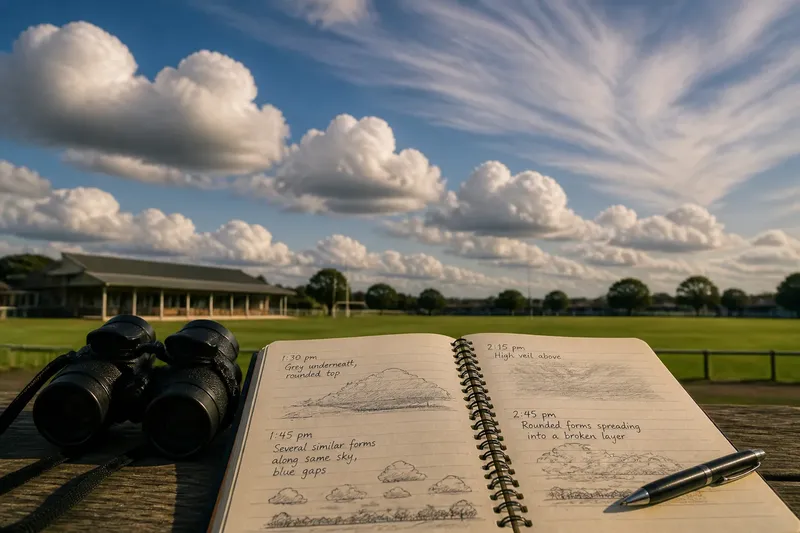
- Keep a small notebook. Write down the date, local sunset time, cloud cover and the horizon feature nearest the setting sun. Clouds may hide the exact moment, so mark that observation as obscured instead of guessing.
- Compare the sun’s setting point. The sunset point shifts along the horizon through the season. A roofline, distant ridge or compass direction can help you notice that movement, but do not assume the sun sets in exactly the same place on the solstice each year.
- Look at sunrise as well. If you can observe it safely from a familiar eastern view, record its clock-time separately. The dates of the earliest sunrise and latest sunset do not generally fall on the solstice either.
Imagine you begin a notebook in late June, with a clear view over a distant ridge. You write down the clock-time of sunset and the ridge notch nearest the sun. On later visits, the sun may set a little farther along the ridge and disappear later by the clock, while your note about dusk arriving earlier signals that the total daylight span is already easing back. The expected observation is not a dramatic leap, but two gradual changes that do not peak together.
What can change what you see?
Local surroundings complicate a simple comparison. A nearby hill can make the sun disappear earlier than it would at a flat, unobstructed horizon. Haze may soften the solar disc, while cloud can conceal the moment altogether. These effects change the visible sunset, not the underlying position of the solstice in the seasonal cycle.
Longitude matters too. Two places in the same time zone can have noticeably different clock-times for solar noon and sunset because the time zone uses a shared civil clock across a broad area. A place near the zone’s western side will generally experience solar events later by the clock than a place farther east at a similar latitude. Local daylight-saving rules can shift displayed times as well, so compare records from the same place and note the clock convention.
For a clean comparison, use an almanac or a reputable sunrise-and-sunset calculator set to your location, then treat it as a companion to observation rather than a substitute. It can show the predicted times and day length. Your notebook records what the local horizon and weather actually let you see.
Which dates and observations answer common questions?
Is the summer solstice always the longest day?
For a location in the Northern Hemisphere, the solstice is the point associated with the year’s longest daylight span. The precise span depends on where you are, and polar regions have unusual patterns, but the solstice still marks the seasonal turning point in the sun’s path.
Why does the earliest sunrise come before the solstice?
The clock-time of solar noon shifts through the year, so sunrise does not move in lockstep with sunset. Near the summer solstice in many northern locations, the earliest sunrise occurs before the solstice; after it, sunrise can become later even as sunset continues to move later too.
Does the latest sunset happen on the same date everywhere?
No. Latitude, longitude and the local time-zone arrangement influence the date shown on the clock. Use a location-specific calendar or calculator if you need an exact date, and keep any field comparison tied to one observation spot.
Is twilight the same as sunset?
No. Sunset is the moment the sun passes below the horizon; twilight is the changing light that follows. The length and appearance of twilight vary with place, season and conditions in the sky, so a bright western glow is not a reliable marker for the sun’s actual setting time.
What is not worth the effort?
There is little value in trying to identify the latest sunset by memory alone, especially if evenings are cloudy or your viewing position changes. Nor does an elaborate instrument help much for this simple observation. A steady viewpoint, a consistent clock and a few dated notes are enough to reveal the pattern without turning an evening walk into a precision exercise.
The useful distinction is simple: the solstice marks the year’s longest daylight span, while the latest sunset is a clock-time extremity shaped by the sun’s shifting apparent schedule. If you search for “latest sunset after the summer solstice” for your own location, pair the date with a short run of observations. You will see not one sudden reversal, but a quiet mismatch between a daylight interval that has begun to shrink and an evening sunset that is still arriving later.