Why the Afternoon Sun Seems to Move Across a Room
Why the afternoon sun moves across a room: learn to read the changing angle of window light and tell direct sunshine from a bright patch of sky.
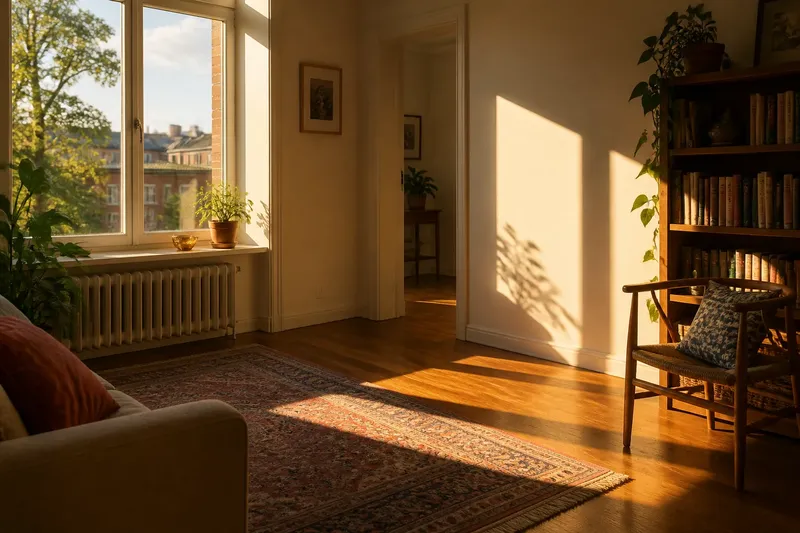
The common mistake is to assume the sun is shining straight through the same part of a window all afternoon. That can leave you wondering why a bright stripe has shifted, vanished or appeared on a wall that seemed out of reach earlier. The afternoon sun moves across a room because the Sun’s apparent position changes, altering the direction and reach of light through each window.
Why does the afternoon sun move across a room?
Earth’s rotation makes the Sun appear to travel across the sky from east to west. As its apparent position changes, sunlight arrives from a different direction and at a different angle. A window admits only the rays that can pass through its opening, so the illuminated patch on the floor or wall shifts as the afternoon goes on.
Imagine a sunlit patch beginning near the edge of a rug, then gradually crossing towards a bookcase as the afternoon advances. The patch has not travelled independently: the angle of the incoming rays has changed. Its path may be easy to follow on a clear day, while thin cloud can soften its edges or hide it altogether.
The room’s layout also shapes what you see. A deep sill, nearby building, tree branches or balcony can block low-angle rays. Furniture and interior walls catch the light where it can reach, creating a bright patch, a sharp shadow or a narrow band along the floor.
Why does the light reach farther later in the day?
When the Sun is lower in the sky, its rays enter a window at a shallower angle. If they clear the sill and any outdoor obstacles, they can travel farther across the floor before meeting a wall or piece of furniture. Earlier, when the Sun is higher, the same opening may cast light onto a nearby wall or a smaller area of flooring.
This is not a rule that every room will show a longer stripe as afternoon progresses. A building opposite may block the low Sun; an overhang may cut off the rays; or the window may face away from the afternoon Sun. The change depends on the window’s direction, its surroundings and the room’s shape as well as the Sun’s position.
Watch where the boundary between sunlight and shade falls. If it slides along the floor while retaining a fairly defined edge, direct sunlight is likely reaching the room. If the whole area simply brightens without a distinct patch, light may be arriving from the sky rather than as a beam from the Sun.
Does every window get afternoon sunshine?
No. A window’s compass direction helps indicate when it may receive direct sunlight, but the view outside matters too. In the northern hemisphere, south-facing windows often receive sun during a broad part of the day, while west-facing windows are more likely to catch later light. In the southern hemisphere, the broad pattern reverses.
Those are tendencies, not promises. Nearby buildings, rooflines, hills and trees can alter the view of the sky. A west-facing window under a deep porch may stay shaded, while a window in another direction may catch a low Sun through a gap between buildings. The season also changes the Sun’s path, so the same window can receive direct rays at one time of year and miss them at another.
For a simple observation, stand inside and look at the window rather than guessing from the room’s compass direction. Notice whether a defined patch reaches the sill, a nearby surface or deeper into the room. Return later and check what changed: the direction of the patch, its reach, or whether direct sun disappeared. This uses the light itself as a guide, with no equipment required.
How can you tell direct sunlight from bright window light?
Direct sunlight tends to make a more distinct area of brightness and a clear-edged shadow. Diffuse daylight, scattered by clouds or arriving from a large area of sky, usually spreads more evenly and softens shadow edges. Both can make a room feel bright, but only direct rays produce the moving sun patches many people notice on walls and floors.
To compare them, look at the edge of a shadow cast by a chair leg or plant. A crisp edge suggests direct light; a soft edge suggests more diffuse illumination. Do not rely on brightness alone: a clouded sky can light a room strongly while hiding the Sun’s disc and eliminating a sharp beam.
Glass can complicate the view. Reflections may place a bright shape on another surface, and patterned or coloured glazing can alter the appearance of incoming light. If a patch seems to jump in a way that does not match the window’s direction, check whether it is a reflection rather than a beam passing straight through.
What questions help explain a changing sun patch?
Why does a sun patch disappear on a clear afternoon?
The Sun may have moved behind a roofline, tree or neighbouring building, or its rays may no longer line up with the window. A clear sky does not mean every window has an unobstructed view of the Sun.
Why does the patch move faster near a wall or corner?
A patch can appear to move unevenly because the floor, wall and furniture sit at different angles and distances from the window. Its visible edge may also be cut off by an object, making the movement seem to change pace.
Why does the same room look different on another afternoon?
Cloud cover can soften, interrupt or scatter direct light, while seasonal changes alter the Sun’s path across the sky. A slightly different view through leaves or a gap between buildings can change which rays reach the room.
Can window direction alone predict where the light will land?
It can suggest when direct sunshine is possible, but it cannot show exactly where the beam will fall. The window’s height and depth, outdoor obstructions and interior surfaces all affect the result.
What is useful to notice, and what is not worth doing?
Keep the observation simple: choose one window, note the room surfaces touched by direct sun, then look again later. If you want to compare another day, use the same viewpoint and look for broad changes rather than trying to record every passing cloud. The aim is to notice how the window frames a moving direction of light, not to produce a precise forecast.
It is not worth buying a compass, plotting the Sun’s path or measuring the patch to understand an ordinary room. Those tools can answer more technical questions, but the shifting edge of sunlight already reveals the useful part: which direction the rays arrive from and how far they reach before something blocks them.
Next time the afternoon sun moves across a room, follow the boundary between brightness and shade rather than the bright patch alone. That edge shows where direct rays stop, while the softer light beyond it tells you how much of the sky is still brightening the room.